Pension planning

So I think a lot about pensions. Pensions are by far the biggest topic when I talk to women in the same sector as I am. Or single parents. Or anyone who has moved between jobs, or between traditional jobs and entrepreneurship. So, everyone really.

There are a few different schools of thought. Many younger people I speak to have such little faith in the pensions industry that they are not convinced of the need to invest in retirement vehicles. In fact one-third of savers don’t have faith in the industry – and this survey was done with savers, so imagine the additional people who don’t have faith to the point where they just don’t save. Almost 60% of people believe they will not have enough to retire on, with women being significantly less confident about their ability to retire at all, or comfortably.

Not totally relevant but much more interesting than pictures of currency notes and clocks. Photo by Ricardo Gomez Angel on Unsplash

I’ve written a couple of times about calculating what you need to retire on, and on working out across your own financial journeys, especially if you want to retire early, where you might have gaps in your income prior to being able to access pension funds.

One tricky area to work through is the difference between defined benefit and defined contribution pensions. Sometimes I imagine myself on the Dave Ramsey show explaining at length why I don’t have $1million in retirement, and why that doesn’t matter because I am largely in defined benefit pensions. I realise that we have now plumbed the depths of my boring internal monologue, but putting that aside, let’s continue.

The first point is that defined benefit pensions are largely in the public sector, and they are increasingly rare. The second is that you will very rarely be able to choose which one you get. You may, if you are joining public service, be offered this option. And – whislt I don’t normally give unequivocal advice – you should always choose defined benefits for the reasons outlined below:
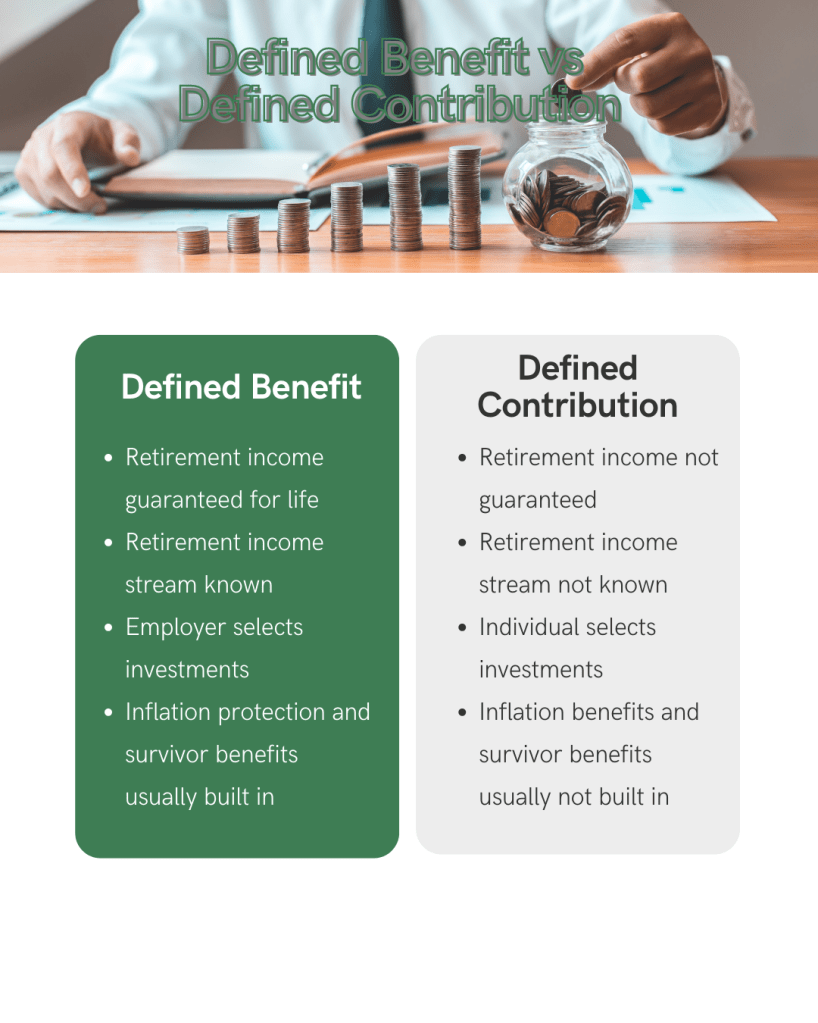
Some of the differences across pension type

Defined benefit pensions are usually linked to the length of service in the company, so it can feel pretty small or silly, but it all adds up. The greatest benefit to defined contribution is that a) you can choose where to invest the funds yourself and b) you can usually roll pension contributions into a single fund as you move jobs.

I have three defined benefit pensions, and one SIPP which I invest into regardless of how good my company pension looks. The figures below assume I stay in my current job for another two years: many defined benefit pensions require a minimum stay with the organisation. So how do my pensions look?

  Transfer valueAnnual guaranteed
income retirement
Defined benefit pension 1 £          62,304 £            6,250
Defined benefit pension 2 £          39,462 £            1,400
Defined benefit pension 3 £        104,864 £          15,266
  £        206,630 £          22,916
Self Invested Personal Pension (SIPP) £          44,075 £               400
TOTAL ACROSS ALL £        250,705 £          23,316

Even a quick glance suggests that the benefit from the defined pension is better than the defined contribution on the SIPP. However – and it’s a significant caveat – the SIPP will grow with the market. Or hopefully grow, in these days, who knows.

This is where it gets interesting. Using the more traditional FIRE rule of 4% withdrawal, to achieve the  £30,000 per year in retirement I would need to save £750,000 overall. Side bar – Mustachian Calcs are great calculators for working this sort of thing out. As you can see, I am not far off from that £30,000, and indeed would reach it if I could add in the UK State Pension (caveats galore!) but my portfolio ‘value’ is only around one-third of that net worth calculation.

Definitely more on this in blogs to come. It’s both a tangled old web, and a cornerstone of what we’re trying to do here. So do come back and join me on Instagram for more.

Mind the (early retirement) gap

Quick reminder to come and join me (and the FIRE community) on Instagram @brilliantladiesmoney. At least join once a week for the Friday Banger – music that inspires me on my journey – definitely my favourite moment of the week. From Sauti Sol to Sizzla (plus artists who don’t begin with S), it’s all the tunes that get me back on track.

Following my posts on working out what you need to retire on and looking at where my current portfolio will take me I wanted to talk about the early retirement gap.

Unsurprisingly, most non-FIRE retirement discussions focus on investing in pensions. Paying into pensions is a tax efficient way to save, and has the added benefit of hiding your money from yourself so you can’t change your mind about your future plans and spunk it all on a beach house. But the early retirement gap is the time between quitting traditional employment and being able to access your pensions.

Mmmm beach house though. Photo by Harshil Gudka on Unsplash

Looking at my portfolio really showed how critical this gap is. Since my assets are heavy on real estate and on pensions, there is a gaping hole in the middle where more flexible options should be. Add in the need to wait for pension income, and it might be time to rethink the plan a little.

So I went back to basics in terms of what I will need and when, and mapped out income against it. This resulted in a long and complex spreadsheet which I won’t share here but started from the premise of living until I am 80. I already wrote about being at the ‘tail end’ or probably half way through my allotted time on this earth – and I would caution that you think about this stuff when you are in strong existential form as I found it quite depressing. Anyway – it’s infinitely less depressing than not thinking about it and ending up broke, so here we go.

You will see I put in some assumptions and I wanted to unpack two of these a little. The net result though if I follow my plan to retire at 50 is three years where my expenses will still be super high, then 15 years of gap until pensions kick in.

The impact of having kids and the choices we make. I don’t know where I would be financially if I hadn’t had children, but without them I could already retire on my current portfolio. I wouldn’t change them for the world of course – this is purely a financial observation. If you want rantings about how the system is stacked against single mothers, then pretty much the rest of the blog awaits you.

One big question though for the next phase is about whether I support my children through higher education, assuming they want to go. I have already committed to putting them through private schools, most of which is based on the fact that we move country every three years and need some consistency. Part of me absolutely wants to make sure they get through university debt-free. Whilst debt levels in the UK is still nothing like the USA, it is heading in that direction. On the other hand, with the right money mentality and guidance, there is nothing to stop them getting scholarships, working and managing what debt they had to get through on their own. The FIRE community tends towards the latter, with Mr Money Mustache in particular being vocal about both reducing costs for college and letting your children use the tools you have given them and find their own way.

I looked at the most basic costs for a UK college education and it would add around £20,000 per year per child to my expenses. Because of the age gap between my kids, I would need to cover this for six years, three of which are after my planned early retirement date. So that’s likely £120,000 in total that I would need to earn in that period in order to cash flow it.

In some ways this is a conversation that will never end though – will I help my kids buy their first house, look after their kids for them, whatever else? Or just focus on not being a burden to them and help out when I can? It is one of the times I hate being the only parent giving financial support, because whilst I don’t want them to miss out, it’s a lot.

Will an Oxford education even still be relevant in the future? Photo by Ben Seymour on Unsplash

Pension dates and what the future looks like. This is another interesting question which I never really thought about until I hit 40 and my future as a creaking elder suddenly felt a whole lot closer. Most of the US podcasts on FIRE assume that pensions kick in from 59.5 but in the UK – at least with pensions in any way connected to the public sector – pension age is 67. This really does add a lot of years that have to be covered by investments or income. By the time I retire, this could easily be 70 years old. Public sector pensions may be great because they are defined benefit but they are also pegged to the national pensionable age so there is a chance these will all shift to be much later. And pensionable age continues to increase, as the overall population ages and there are more people drawing pensions than paying into them. Which I understand but it’s hard to plan when the goalposts keep moving.

I have also bravely added in the UK State Pension which I struggle to believe will exist as anything other than a means-tested benefit by the time I retire. And whilst at £716 per month or £8,592 per year, it’s not enough to live off it would make a significant difference to how much I need in my overall portfolio. However I hold it very lightly as a possibility in spite of paying tax and NI for my whole career, even the overseas year. We already have ample evidence that the UK Government will not hesitate to shaft women (and by shaft I mean change the age at which they can access their pension with almost not notice, then underpay women £1 billion and not even bother to try and clear it up) if they think they can get away with it.

Planning for the sunset years <cries in Young Person> Photo by Jason Blackeye on Unsplash

So that is how it looks. The gap is real but thankfully there are a number of ways to think about filling it without having to stay in full time employment – more on that in a future post. For now though, working out exactly what this looks like and what the options are makes me feel more confident about making movements.

What does your early retirement planning look like and how are you thinking about future support to your kids?