This blog was born because I couldn’t find anything like it. I started it as a single British woman in my late thirties, living with my two primary age children when we had just moved to Denmark. As of 2024, I am in my mid-40s, with all the joyful tween and teen years for my children that entails. And whilst we are still in Denmark, my career means that I expect to move countries in the coming years.
I started this blog through a love and interest in the Financial Independence, Retire Early (FIRE) community. However, whenever I needed advice or a community to talk to about being a great single parent, living on a budget, or planning my side hustle, I struggled to find information that resonated. Sometimes it was because I’m single; other times, because I felt I had a different ethical approach which I didn’t see reflected. If you have similar needs, or just want to see a real story of personal and financial growth during what sometimes feels like times of real challenge, I hope this blog can be a great space for you too.
I cover several main topics focused on financial independence, personal finance, social justice and lifestyle management all through my own personal journey:
My Personal Financial Journey: I walk you through my own experiences and challenges as a single mother working towards financial independence. This includes dealing with emergencies, budgeting, and managing household expenses, as well as making long term financial decisions for my children and wider family.
Financial Tips and Strategies: Whilst I don’t give advice I aim to provide practical thoughts on money management, including tips on setting up an emergency fund, being savvy with money. I also share how I try to spend mindfully toward the life I want to create, whilst optimizing on spending like meal planning, travel, and activities with my children.
Financial Planning: I also share my own journey of planning for the short, medium and long term, looking at retirement planning, raising money savvy kids, and preparing for my children and other loved ones’ financial futures. A lot of this links to career planning and how (and why) I think about getting to ‘work optional’.
FIRE Community and Inspiration: Whilst not everything resonates, I have found a great FIRE community with a lot of inspirational stories and resources from well-known figures in the community, such as Tiffany Aliche (The Budgetnista), Paula Pant, and Mr. Money Mustache. I also regularly share recommendation for podcasts and books that are helpful for financial education and inspiration based on what I am finding interesting and useful as my journey continues.
Policy and Social Justice: Personal finance might be personal but it doesn’t happen in a vacuum. I aim to explore policies and trends which impact on our money including cost of living issues, issues impacting the stock market, and changes in budgets and taxation relevant to a UK audience. I also focus on social justice and how I understand that neither how we make or spend money is the same for everyone.
Goal Setting and Accountability: I highlight and give tips on the importance of setting realistic financial goals, having an accountability partner (and what that looks like for single parents particularly), and staying focused on financial plans is a recurring theme. I share my own goal-setting process and regular reflections on progress, both financial and how I am feeling about it all.
Disclaimer: The content on this blog is for informational and educational purposes only. It is not intended as financial advice. Please consult with a qualified financial advisor before making any financial decisions.
I wanted to start off (because I know you love a relaxing subject) by reflecting on shame around money. There is a lot about this in terms of getting over feeling shame or guilt about having a low income, or having money troubles and that’s a really important conversation. My own family story with money is a mishmash of being low income with middle class aspirations, meaning that between my family and the people I grew up with had very different incomes, aspirations and feelings about money. I also work in a ‘helping’ industry where there are expectations that we shouldn’t earn as much as e.g. bankers because we are working for a higher purpose and should do it for the feels and not for the remuneration.
So there is a lot mixed up in how I feel about money. On one hand, I am working in a job which helps people, and which I got after working almost 20 years in jobs which paid around the median wage whilst studying on the side as a single mum to achieve, and pay for, a Masters and PhD. On the other, I recognise that I significantly outearn pretty much everyone I know. I guess this would be different if I was in the USA, where every single caller on the financial independence podcasts I listen to seems earn a similar amount to me.
This is a topic I will likely come back to, but I have been uncertain about posting both my spends and savings for 2023, because I am not sure how I feel about being public on an area which has so much judgement. But to make this blog useable and useful, it strikes me that real numebrs are better than theory. So with your kindness, here we go.
Total savings 2023
SIPP personal pension (invested)
£ 3,600
ISA savings (invested)
£ 15,000
Work Pension (pre-tax – invested by company)
£ 15,552
One year living expenses (cash)
£ 48,029
Total Saved 2023
£ 82,181
Children’s savings
Childrens’ ISA (invested)
£ 2,800
Childrens’ Junior Pensions (invested)
£ 1,200
Total Saved 2023
£ 4,000
Average monthly savings
£ 6,848
I have to say that I am pretty happy with that. Compared to my spending of£88,344, savings of£82,181 means I saved almost 50% of my income. This is significantly better than other years, and definintely something to aim for moving forward. This has also been the first year I had zero debt other than my primary mortgage – in 2021-2022 I was paying off a bridging loan I had needed to buy this house, and in previous years was significantly overpaying on the mortgage for my rental. So there was definitely more available to save this year, though all those actions contributed to my net worth.
There need to be some tweaks to how I manage things, based on changes and additional risks in 2024, so I will use this information to guide my planning and goals for 2024.
But I am both proud and slightly guilty at the same time. So something else to work on too!
How was your savings rate in 2023, and how do you feel about it?
Come and join me over on Instagram, for regular tips on money saving (ok, very often about meal planning and grocery budgets), simple pleasures, mindful money and of course, weekly hang outs with the Barbies who are also here to inspire you!
Since we are about to end the 2022-23 tax year in the UK, it’s the time of year I always calculate my net worth. I also did this in December, but since I had just sold my rental property and was calculating expenses, taxes and so on I kept some back for those purposes. Now the dust has settled, I have a much clearer picture.
This time last year I was writing about how it feels to be at almost $1 million net worth. Interestingly, and largely thanks to changes in FOREX rates and that I have my investments in sterling, my dollar net worth hasn’t changed much and now stands at $980,000. But the true amount has increased: from £ 717,677 to £793,000 or an overall growth of £75,324 over one year.
That equates to an increase of more than £6,250 per month which I can feel pretty proud of! It has also been a shocker of a year in terms of the markets, soaring cost of living and a whole bunch of other apocolyptic doom feelings.
And it’s a reminder that time in the market rather than timing the market, and keeping consistent, is more important than looking for tricks.
So what is my portfolio made of?
With the sale of my rental, this is now much less heavy on house equity. I have split my savings into two here – one is the investments I have, and the other is a chunk of money which I intend to use to buy a rental property, and about £100,000 set aside for other investments and savings opportunities.
Pensions
£ 288,826
Savings
£ 68,711
House Equity
£ 90,464
Money to invest
£ 345,000
TOTAL
£ 793,001
The main growth has been in ‘money to invest’ – largely because I worked out all the house sale costs and this is the final figure – and also in pensions. I pay a significant chunk to my employer pension which is also matched, and I also added to my SIPP when I sold my rental.
I always find it interesting how people calculate their FIRE number and what they need to live on. In theory I need £30,000 per year in retirement. Using the 25 x income calculation, would mean aiming for a net worth of £750,000 which I am already above.
But there are a couple of issues with this. One is that my pensions can’t be accessed until 67 (or if all the pensions changes proposed come to pass, 100 years old by the time I get there). The other is that retiring on that money assumes that my kids are financially independent. I spend a lot more than £30,000 at the moment (I would say largely on them though I am sure they would disagree), and it’s an interesting moment of reflection about the choices I am making for me and the kids, and what our options are. My net worth also doesn’t include a paid for house any more, and my calculation of income required on retirement assumes that I have one and therefore don’t have a mortgage or rent.
So that’s it. There are other very small pots in there like crypto and angel investments, but these are the real pillars of my financial plan. But the pot is growing, and I am staying on the path. Kudos to all of you following your dreams of independence!
The clocks changed last night: this is how British people refer to daylight savings. I realised it is not universal, but since this is a post focusing on the UK tax year we can just start there.
So, the clocks changed, the snowdrops are out, and its raining rather than snowing. That can only mean one thing: the end of the tax year. I’ve been talking about this – like all of it, the flowers, the weather and the financial planning – over on my IG page. Do come and join me, a lot of this is more fun with pictures.
Since 1753, for various nefarious reasons, the UK tax year runs from 6th April-5th April the next year. That means there is a week until the 5th April deadline for the 2022-23 year ends, and since the 6-10th April are also public holidays (quaintly referred to as Bank Holidays, honestly I didn’t appreciate how idiomatic British English is until I moved away) there are just eight working days to put in play any transactions relating to this tax year.
There are a couple of big things to be aware of in terms of the tax year:
If you self assess for tax, you will need to get ready for the end of the year and for doing your tax return;
Each tax year you get tax-free allowances which mean you get to keep more of your money through savings, pensions and other approaches. It’s all very simple but if you don’t use the allowances you lose them.
Of these, I will come back to planning your tax return (clue – I *love* doing mine). As more of a global blog I won’t go into the details on the second point but key things to look into are a raise in minimum wages for 21-22 year olds, but also a raise in national insurance in order to pay for social care. For this post I want to talk through some of the allowances, just in time for you to put them into play.
You can max out tax free savings vehicles. The main one for most people is an Individual Savings Account, or ISA. There are multiple different types in the UK, but your money grows tax free. You can invest up to £20,000 per year. There are tons of benefits here – you don’t pay tax on any of the growth, ever, and since you can place it in a stocks and shares ISA you have a decent chance of it growing a lot. There are other options including Lifetime ISAs (though these are open only to people below 40, and are closing out). ISAs need to be opened or rolled over each year and money needs to be paid in before 5th April. If you don’t reach the £20,000 contribution allowance you just get it again next year – and it’s totally worth setting one up however much or little you can put in.
This is also true for savings vehicles for your children. Junior ISAs (JISA) have an allowance of £9,000 per child per year and with stocks and shares JISAs and the power of compound interest, this can make a huge difference in financial planning for your children.
Also thinking of savings for kids, there is the option to open a Self Invested Pension Plan (SIPP) just as there is for adults. The allowance is £3,600 per child per year and whilst the account moves into their name at 18, they cannot access the money until age 57. Again, the power here is from compound interest so even a tiny amount can be worth it with the tax benefits thrown in as well.
For adults, the SIPP allowance is also worth investigating, especially if there are limits to your workplace pension or other options. This year you can pay in up to 100% of your gross annual earnings up to a maximum of £40,000 which will increase in 2023-24 to £60,000.
If you are married then there are tax free allowances you can take advantage of. It’s possible to ‘share’ a tax allowance with a spouse depending on your different earning levels. Doesn’t apply to me so have not looked into it deeply, but it’s worth noting.
Finally, check your tax code. It is your responsibility to do this – whilst there is a tax free allowance for income tax each year, the wrong tax code can mean that you’re paying too little or too much, and that can come back around when you least need an extra bill.
I hope that has been useful! Remeber – with the time left, you could open a new account and max out the allowances before the end of the year.
Reminder on the disclaimer: I am not a qualified financial planner or advisor and none of this blog or post constitutes ‘advice’. Treat is as seriously as if you were chatting to someone super interested in a subject at a bar. So you might find out something intersesting but you definitely wouldn’t act on it until you took other advice. Cool? Cool.
Having written just a month ago about grief, I am devestated to say that my father passed away this week.
He has been ill for many months so it wasn’t a surprise. He went quietly as he would have wanted to: fell asleep holding my mum’s hand and slipped silently from this world during the night. We had a lot of time during his illness to share our love and our feelings with him, so he went having ensured that we weren’t left with ‘things unsaid’ – those things which can become toxic after someone’s passing.
A rainbow, picture taken by my daughter the day my father passed away. “Look,” she said “a little gift from pa.”
But it is still unimaginable to me that this world continnues to exist without him in it. I believe that he is with God, and that his spirit will live on – those that we have loved never truly leave us. So I thought I would use this post to celebrate that spirit and his life, and share some of the lessons he has given me over the years which I will take with me and keep sharing with my children.
There are some areas where you shouldn’t try to save money. Namely: books, wine, cheese. Books are something I try not to keep buying, partly so my home doesn’t end up with teetering stacks of books in every corner and partly so I can give up on a book I’m not enjoying rather than feeling the need to see it through ‘since I paid for it’. But I am prepared to rethink this one to pay respects to my dad.
Making people feel loved means seeing who they are and what they need. He came into my life at 14, becoming my step-dad. I call him my dad out of love and respect – and because that is who he really was for me. From the day we first met, he was someone who created a feeling of love and respect with such a simple grace, largely by really trying to understand who I was, how I felt and what I needed. And that effort and level of care was always the bedrock of our relationship, and meant that I could talk to him and rely on him for anything.
Then you show them that love. As a man born in 1939, my dad was maybe not an obvious candidate for showing emotions. But my kids and I have always felt supported on a kind of cloud of love and affection. When we were living overseas he sent a weekly package of cuttings from the newspaper (often with speech bubbles or other commentary so it was clear where he stood), letters, and little notes he had taken about things we’d be interested in. I find little cuttings, notes and letters, throughout my house: tucked into recipe books, or mixed in with the kids’ stuff. And I love to see them.
Poetry is not a luxury. He really loved poetry and is one person who consistently gave me books of poetry as gifts. It’s not something I do for myself, but every few weeks I pick up one of these books, let it fall open, and just enjoy the small, beautifully written treat within. I added this activity – poetry i-Ching if you will – into a list of ‘5 minute treats’ recently and I love it.
Love hard. It’s worth it. My parents got married after messy divorces on both sides. They learned to trust each other, and built a successful life and family. That’s a lesson worth learning.
Unconditional love is rarer than you think. My dad was the only person who cried with joy when I finished my PhD (apart from me but I cried with relief) and I gave them a bound version which referenced them in the acknowledgements. For my mum, it was too tied up in needing to compare my achievements with my siblings. But for my dad, it was much more simple: “You did a great thing. And I couldn’t be prouder.”
Cycling drunkenly into a hedge is a family thing. Don’t sweat it. (Just gonna leave that one there without an explanation!)
Grief is hard. Loss is hard. Relationships with our parents and family can be hard. Parenting and trying to get it right can be hard. But it’s not all hard, or not always. It’s a beautiful, tight hug from someone who really knows and loves you, whatever your flaws. A hug that you can still feel long after they have gone.
Thanks for being here with me at this difficult time. This blog is about all the things that make up a life, and grief and love are part of that. Now go and give someone a hug, or a call, and tell them you love them.
Carrying on from last week’s posts about the cost of school holidays and what I ended up spending, I wanted to share a bit more on what we actually did. I also shared activities and ideas throughout the holidays on this blog’s Instagram account: come and join us!
There was a big shift in my thinking this year for a couple of reasons. One of these is just the age of kids – a lot of my suggestions don’t work if you have younger kids who need a lot more supervision. I would say though that ages about 4-8 are the best for frugal holidays as long as you can take time off work to hang out with them (and that’s a big, big if). Now mine are 9 and 13, they have different needs and opportunities.
The other thing that changed for me was taking an active decision to let my kids get bored.
I have always been clear with them that their boredom is not my responsibility. But there is also tremendous pressure to fill our kids’ time with endless opportunity and stimulation. So much of the insistence that we have our children do so much outside of school is a concern that they will get left behind: without all the extra tutoring, music, sports blahdy blah they will somehow be less rounded, less competitive and overall less successful. If you are in a country where yours it not the majority culture, there might also be language or religious classes or community events which are important in making sure your kids feel their roots. That’s a lot of expectations we’re putting on our kids, and they are exhausted. And so are we.
An article in Psychology Today is clear that parental expectations, and a zombie apocolypse view of the world where missing out on the right college means Your Life Is Over is pushing parents to put too much pressure on their kids. As the article notes, whilst extra-curricular pursuits were a hobby or a chance to try new things,“each activity is now one more area for social comparison and thus one more possible source of stress and anxiety“. Another article sounded the alarm for the impact of this on children in terms of squeezing out valuable family time. A survey in the UK found that 90% of children went to after school activities 4-5 times per week often getting home as late as 8 or 9pm, meaning chances of meaningful family conversation, or a relaxed dinner where you chat through the day, are slim.
Internet suggestion for a photo of borderom 😀 Photo by Tony Tran on Unsplash
Aside from the existentialist question as to the future of Higher Education (which is a whoooole other conversation), cramming in so much to our kids’ days is putting huge pressure on them, but also onto us as parents emotionally, financially and in terms logistics and organisational skills. Especially when there is only one parent and no family around. I don’t want to spend all my weekends watching football or basketball matches (as a side note – don’t attend U11 basketball matches with a hangover. The noise will make you wish you were dead) or schlepping children across town for various activities. Often both of my kids will need me to take them somewhere, attend or support them or whatever, at the same time. And I just can’t.
So with all this in mind, I decided that we all needed a break over the summer. And this meant cancelling a long held plan to go to Kenya for four weeks (there were other reasons for this but actually it was something of a relief in terms of money and having to organise All The Things) and then sitting down with the kids to talk about what a more relaxed and frugal summer meant. I also had to work all but two weeks of the holiday, and travelled for work for parts of three weeks.
So this is what we did:
Getting the most of what we already own
Use holiday clubs when you have to. In previous years I used clubs to keep the kids entertained and busy. This year I only used them for when I was travelling, since they will have a nanny around to keep them safe and fed, but they need more in terms of things to do. My daughter did three clubs which were actually great – explorers, where they went out every day on the train and poked about Copenhagen; analogue photography where they learned to use cameras and to take and develop their own pictures and had an exhibition; and, more randomly, badminton and origami. She loved them, made some friends who then came to play at the weekend, and got out of the house. But the three weeks were definitely enough.
Take a chance to use what you already have. I feel like in spite of general frugality, we have a LOT of stuff. We got out a bunch of things which have been sitting around since we moved, putting up gymnastics rings and a ladder into a convenient tree, and finding badminton and tennis racquets for games in the garden. I threw all our ‘sand toys’ into the back of the car so they would always be on hand. We also spent a few days of my holidays going through all the stuff in my daughter’s room to get rid of clothes, books and toys which she has grown out of. This all went on Freecycle so other families will get to enjoy them, whislt she has a clearer view of things she actually likes. I also encouraged her to get out things she hasn’t used for a while or made time to play with: sticker and activity books, craft kits and so on, many of which were good fun over the holidays.
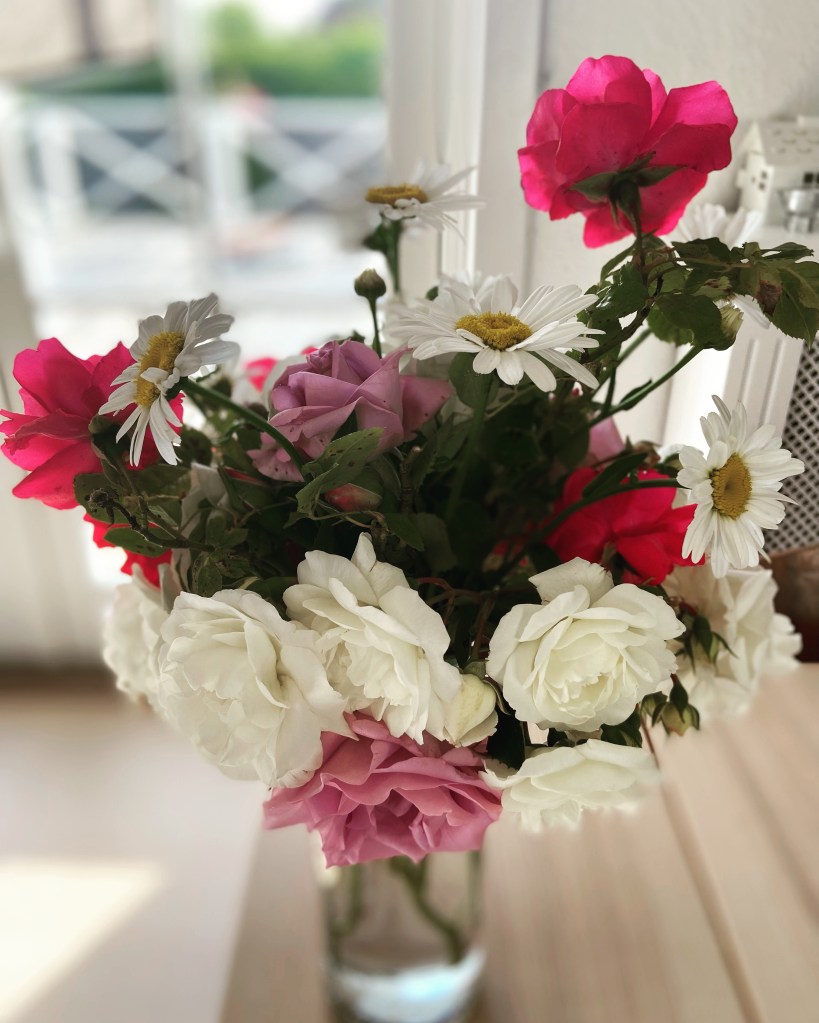
And doing the garden means saving money buying flowers!
Help them think of projects. We also sat down and came up with ideas of things they can work on when I am not there, using what’s around. We thought about things they can do when bored (reading, drawing, small craft things), and projects where I did buy some additional bits and pieces. My son worked his way through some focused phsyics and maths work (yeah, no idea where he gets it from), worked out how to set up a telescope he had for Christmas and spent evenings star gazing and looking up astronomy facts, and practiced his clarinet. My daughter learnt how to use our sewing machine and made clothes for her Barbies, looked after the vegetable patch in the garden, and researched and made bee and insect houses.
Think of stuff to do as a family. We did a lot this summer, but most of it free and none of it ‘thrilling’. We went to the beach many many times. Whilst we used to go for an hour or so we got in the habit of packing a picnic, rugs and books and making a whole morning of it. We walked in forests, around lakes, and all through the centre of Copenhagen which is a great place to explore. I have a couple of memberships we buy annually (to the Danish Architecture Museum which is super cheap and gives you free coffee and to an amusement park which is super expensive but definitely exciting) and we made use of them. We researched and cooked recipes which we hadn’t made before – I recommend doing this with one kid at a time if they are like mine – played boardgames, watched all the Marvel films we hadn’t seen before, and got into a podcast about political systems. It’s all individual, but my point here is that fun doesn’t have to be novel, or fresh or expensive. Treats and time together can be pretty simple.
But sometimes spending on a treat is totally worth it
Spend on things that do make a difference. Brunch or dinner out; a book or a two-month subscription; decent coffee – whatever it is that you will appreciate, do it. The flipside of recognising that throwing money at problems doesn’t solve them is realising that when you do spend mindfully, on things that make a difference to you, it feels that much sweeter.
That was our summer! We had a lot of fun, and saw a lot more of our city. The kids got bored, and got creative. I think we read about 20 books each (either from the local library where we visited weekly, or things which had sat on shelves unread for a while. We cooked, baked, gardened, sewed and played games. And saved a ton of money.
I just missed a week. A whole week over on my Insta and a week of posting here.
I thought about both, over and over. But I was too busy, too tired, too focused on a whole load of other issues in my life and in my head.
It was disappointing because I had a made a commitment to post – to write out my feelings and my journey, give myself time and space to think, and be there to support others. I made a commitment to just show up, and keep showing up.
These past few weeks and months have made me think a lot about commitment. As it’s such a critical part of our life journeys – financially, spiritually, at work, and in relationships – I want to write a few posts about it. They might feel a bit different to how I ususally post so I am grateful for your being with me whilst I think this stuff through.
My first question is – when do I need to choose between commitment and self care?
There is real value in committing to something, and even more in being consistent. But are there times when it is better to waver, and to just look after myself? Is it better to honour my word, or to give that time inwards to rest and recover? Does it matter how I approach that in terms of messaging, or preparation? I know plenty of people who just change their mind and their plans at the last minute, sometimes for good reasons. Am I ok to be one of them?
This is a forked stick I come to often. This post is absolutely not about this blog, but it’s a good personal example of things that I am committed to but I don’t have to do it. I tend to write my blog on Sunday mornings, when I could be doing a myriad of other meaningful things, many of which fall under the heading of ‘self care’. I mean, often it’s getting some extra sleep after a beer or two over the odds the night before (which raises entirely different questions about how I view self care issues against areas of life which are a challenge vs over the easy, but equally impactful, decisions on going out for a drink…). But it might be getting ready for the week, taking it easy, or going for a walk with the kids. So there are a whole load of ways I can talk myself out of sitting down to write, and can validate those feelings.
So – here comes a stinger, for me anyway – a blog is such a strange creature. I know it gets read, but not so much whether anyone cares if I show up week after week. I believe and hope it adds some value, but if I stopped writing, the waves of the internet would soon wash over any castle built on this sand. Nothing would really happen if I don’t show up.
The waves will wash it all away. But what remains? Photo by Sean Oulashin on Unsplash
Which means that the most important thing about the commitment I made to writing this blog, is the commitment I made to myself.
And keeping these promises, without external accountability, are the hardest ones.
Whether I tell you I will meet you for lunch, water your plants, call you on Wednesday, or love you forever – unless something completedly unexpected happens, which it rarely does – I will do it. There are many people not like this (again, a whole other post) but for me, if I say it, I mean it. If I have said the words, you can expect the action.
But I don’t give myself the same kind of respect. If I tell myself I will wake up at 5, stop smoking, get fitter, or love myself forever – these are all totally negotiable.
Which leads me back to the question on how to make decisions between commitment and self care. And over the past few weeks I have concluded this: making and keeping commitments to myself are an act of radical self care.
I am not sure why this feels like news. I mean – this is the basis of a financial independence journey, right? Committing to a vision for a future and regular acts which will create that, are exactly in this space. Nobody else cares if I do it or not. Nobody is impressed if I succeed. Nobody goes hungry (sorry, kids, you will have to get yourselves through college though) if I don’t. But I have such devotion to the belief that God made me to live and contribute through my best life on this earth, and faith in that plan, that I do it anyway.
What is confusing for me is why I struggle with this message in other parts of my life when the core remains absolutely the same. When I have made an agreement as well as a commitment – whether that is to go to work and do my best, or how I try and act as a mum – I can stay in the zone. When it comes to things which feel more optional, especially good habits and high expectations around health and relationships, I find it much harder to be so consistent. I don’t know if it’s a need for results, or a need for reciprocation (or, frankly, whether I need therapy) but everything else feels more fuzzy. More optional. Perhaps I have less faith in how things will turn out. And that is defining how, and if, I show up.
Foundation stones, and building up. Or give up and throw them in the waves? Photo by Zdeněk Macháček on Unsplash
Caveat: bit of a controversial post. Consider yourself warned.
Happy Father’s Day to all the great dads out there. To all those who miss their dads; all those who never knew them; all those for whom ill health, distance, or social norms have made relationships difficult. Basically all the same things I say on Mothering Sunday. All parents matter.
Today I have been thinking about the ‘bitter single mums’ trope which is particularly active on social media on Father’s Day (seriously – why do you have the time? Shouldn’t you actually be hanging out with your kids?) and about a series of conversations I’ve had on toxic masculinity and how men are so undervalued by society that their only possible reaction is violence and disrespect. I am not a psychologist or a social scientist so I am perhaps even less qualified than usual to write this blog, but these are things on my mind so I share them with you, with these caveats in place.
The FIRE movement has a lot of great parenting role models. On a personal level I find the amount of people who reach FIRE based on spending one partner’s income tedious and irrelevant, but I get that for many folk it’s a new way of thinking about family spending. Lots of FIRE people got on this path in order to spend more time with their kids, and to be better parents, and that is something to celebrate. Mr Money Mustache has a lot to say on parenting his son, including since he and his wife divorced. Brad and Jonathan in Choose FI are always talking about their kids and how their FIRE pathway has focused on being with their children, and on leaving a legacy.
In fact there are lots of brilliant dads out there, of course there are. My own father, and the father of my children, don’t fall into this category but I don’t hate them for it – my children have never heard a bad word from my mouth about their father. The issue is that I have to make up for it, financially, emotionally, in terms of time spent and choices made and so on. And that’s not ideal but it’s ok. I am very lucky though in that I have an amazing step-father, fathers of friends (two of whom I have been really close to and sadly passed away this year), uncles and all. And I have friends, family and colleagues where I have so much respect for the way the father shows up, that it really inspires me on a daily basis. So I salute all those fabulous men: we see you. You’re doing great.
A Palestinian father bathing his daughter and neice, giving them as much of a normal happy childhood as he can in spite of the chaos all around. Credit: Wissam Nasser
There is, though, an increase in the number of women having to parent alone. There is plenty of blame around this, and there are multiple sides to every story, but the truth is that men are now allowed to absent themselves in a way that society permits. In my personal experience, this lack of involvement doesn’t stop them loudly complaining about how their ex will not facilitate the kind of contact they want with their children. The kind of people who complain in this way are, again in my experience, the same who want contact on a whim, when it’s convenient for them, and will change those times at the drop of a bar bill.
In Kenya, the outgoing President Uhuru Kenyatta has even made the issue of single parents as one of his key concerns. Globally Kenya is one of the countries where women are most likely to become a single parent, with almost 60% of women likely to be single by the time they are 45, whether or not they have children. Kenyatta’s concern was with the rise in the percentage of single parent households from 25% in 2009 to 38% today. I am not Kenyan but I lived there for a long time and intend to return for the RE aspect of FIRE (watch this space for posts on that thought process, white privilege and colonialist mindset – I’m here for self critique and growth as well, of course). It is one of the places where I find being a single parent the hardest, since even though there are so many of us, it is seen through a lens of shame and ‘burdenhood’ which basically makes me a social pariah. This kind of nonsense article, which paints women as insatiably greedy and self-centred, character developing then abandoning poor, defenceless Kenyan guys, just fills me with rage.
It’s also ironic when – look, I’m just going to say this and take the flack – Kenyan men are seemingly happy to pay for a whole lot of whatever when it comes to relationships. And I mean prepared to pay rent/transport/salon for your side chick (girlfriend) for years, but you think that I, as someone who earns 10 times more than you, is going to be a financial burden? Kthxbye.
There is also a growing narrative around the issues of toxic masulinity, and how men feeling undervalued, undermined and unable to navigate the changes in society mean that they are struggling to find ways to act as men, husbands and fathers in this brave new world. Masculinity itself isn’t toxic, that much should be obvious. So challenges men are facing are absolutely something which we need as a society to deal with in order to create a world that works for everyone. But at the same time this cannot be an excuse for gender-based violence or refusing to look after your own children. And it will bleed into the next generation. If you as a man are struggling with masculinity and shifts in social expectations, it should be obvious that if you have children – and not just sons – they will need you are a role model to work through those challenges with.
In short, we could all do better. This world is not binary: most parents are both good and bad depending on the day. I might be doing it alone but it doesn’t mean I am any good at it, just that I don’t have the luxury of deciding to step out for years at a time.
And I am all for putting in the work to create a world where men feel appreciated, valued and heard. Where they can grow into their power in a way which doesn’t involve crushing (either physically, emotionally or financially) the women and children in their lives. That’s something that we can all believe in. Happy Father’s Day.
With apologies in advance that this blog isn’t the jolliest place to be, I do want to tangle with some critical topics as well as being here for encouragement on these journeys. There is so much content out there about how easy financial independence is – just get out there and do it!! – but it doesn’t ring true for me. It is absolutely not impossible, but if the system is stacked against you, you will feel the burn a hell of a lot more. And for me, I am comfortable in both looking at my own journey and how it’s working, and what is going on out there which is impacting others – and what some of this means for equality.
I’ve written a lot about specific elements of the system and how it works either for or against particular minorities (check out posts on how racialised the financial systems are plus the financial constraints and stacked barriers for single mothers. I also want to say up front that I recognise the privileges that I come with so I am not saying this to ‘own’ or appropriate these issues, but to talk openly about areas where and how I am tangling with them personally. In my view, refusing to acknowledge how systemic power structures work is part of institutionalising privilege in order to extend it’s power, so calling it out has to be part of how we can meaningfully respond. I also find it both essential to understand in terms of why things feel like they move so slowly for me.
The impact on being able to buy is significant. Women need over 12 times their annual salaries to buy a home in England: a whacking 50% more than men, who need eight times. In London and the South East, which are both the most expensive areas of the UK and the two where the gender pay gap is largest, women need 18 times their annual earnings. Given that the very most British mortgage companies are likely to lend a maximum of five times annual earnings – an amount which is anticipated to reduce as inflation bites – it means that these women will never be able to buy a home without external support.
There were two other statistics which felt like a slap in the face. Firstly, there is no region in England where private rented housing is affordable on a woman’s median earnings. This is not true for men, where this is only the case in London. Secondly, single mothers are two-thirds of all statutory homeless families with children (i.e. the groups of people for whom the State has to take some responsibility), a figure which is striking when they are only one-quarter of all families with dependent children.
Basically there is zero chance to single women on median incomes and don’t have any additional financial support to either buy or rent in the majority of the UK. That feels pretty terrifying to me. I earn a (significantly) above average salary and managed to get on the housing ladder early. But under these socio-economic shifts my mum as a frontline worker and single parent would not have been able to buy a house, something which would have seriously impacted on our security growing up; how well she will manage in her old age; and what generational wealth looks like. And what does it mean for my daughter and how I should help her plan for her future?
I’m obsessed by this house I can’t afford so sharing it just because why not
So what is the point of this post? I am not on a median income, and I own both a home we live in and a rental. I haven’t been able to get to the point where I can leverage them into any kind of real estate empire though which seems to be some magic formula for at least those in the US working on FIRE but I am unbelievably blessed to even just have a foot on the ladder. Some days I need to both recognise the luck that I have had in the draw, and how things are looking for others. And why this should matter for all of us: we never journey alone.
Quick reminder to come and join me (and the FIRE community) on Instagram @brilliantladiesmoney I am probably more fun there 😀
I’ve had lots of topics in my head this week to write about – the possible impact of inflation in investments; how to get started with real estate; my tax return (I am SO MUCH FUN at parties). But sitting here this Sunday morning I just feel – crappy. It’s been a busy few weeks but it has felt sort of like a deflating balloon: handing off at the end of my temporary promotion (after almost nine months of working my ass off); hitting some financial walls that I wasn’t expecting; finding it hard to get the enthusiasm together to plan for the summer, which should be exciting but I. Just. Can’t.
I mean, really. Consider how many people in your life ask this question becuase they care about the answer. Credit Finn /Unsplash
I feel lonely. And that’s a difficult spot to be in and stay motivated. There is something about having to constantly be my own cheerleader, my own auditor, commentator, coach, tiger mom or whatever else is just exhausting. Right now, nothing is motivating me enough to play all these roles and keep myself on track. I want to just lie down in a dark room – and unless I can pull myself out of it and get back to a place of peace, that is exactly what I will end up doing.
It is also hard to accept that when you start growing into your self, you leave people behind. The simplest antidote to loneliness feels like it’s company. So we go and hang out with those friends at the bar, take someone home for the night, get into social media scrolling. But all those things feel so empty that they can make the loneliness feel worse – make you feel like you are creating white noise instead of real connection, to distract yourself from doing the hard things.
Somewhere between these two things is where I am spending a lot of my time at the moment. I’m struggling with my own judgement about what matters, who to trust, and how to voice my needs. Honestly, I am scared that the depth of my need for closeness means that I am prepared to overlook a lot of small things which are flags that there are people who aren’t really that bothered about me after all. And I just don’t know where to go with that at the moment.
I wrote a post in January about loneliness, how it is more common than even, and the impact it has on our well-being. In that post I focused on three strategies for mitigating the feelings of loneliness and finding the kind of peace which acts as a foundation when things get rough. The first was building a stronger community, whether with family or friends, all the other Sunderland supporters you can find (good luck with that) or the girls you play Roller Derby with. My second strategy is around focusing on the calendar. Having rituals or activities which mark the passing of the seasons – from new year’s resolutions, spring cleaning, or The First BBQ of the Summer – makes me feel more like an active participant in something positive. Finally perhaps it’s about learning to listen, and to be heard. Building meaningful connections can take time and can be challenging – especially if you are feeling low – but it’s really worth it.
The JFK quote above though is also a reminder that finding peace, which is the first step to pretty much everything else really, is a transformational process even at personal level. It means taking down walls, building up new boundaries, reframing pathways and just keeping on going with the constant shift. This article about the habits that people give up on the road to peace was insightful and is helping me think about my own reactions. It talks about moving away from toxic people, from comfort, from the pursuit of perfection or impressing others, or from holding grudges (this is my own personal favourite).
But even though it sounds obvious, transformation is hard. Growth is painful. Moving away from people, and having that level of certainty in yourself and your pathway, can be lonely and exhausting. Thinking about where you will be in five years might be the right approach when you’re struggling to keep going, but if you’re doing that whilst watching people you have moved on from have The Best Party Ever on IG then it can feel like a fictitious bargain made only in your mind. I have days like today when I forget how these feelings and challenges show up, but I know that I always get through them, however crappy I feel for a little while. It’s ok. We got this.
And if it gets on top, go somewhere that reminds you of the powerful certainties of this world, and get it back into perspective. Photo by frank mckenna on Unsplash


















 Brilliant Ladies' Handbag Club