In January my son was hospitalised, and he has only just been discharged. It is heartbreaking to be living in this season, and the nature of his illness means that it might not be a season, but where we live from now on.
Everything has, of course, been put on hold, including this blog. We were already in a challenging place trying to work out my next job, where we will move to and this means that we have to just pause and focus on keeping us all as well as we can be.
One thing I am so grateful for, other than love from family and friends and living in a country with an amazing healthcare system, is how much financial stability has given me breathing space. I’ve always talked about how financial planning prepares us for disaster, but I never believed it would apply to me. I have seen my money plans as positive pathways to great futures – a way of buying freedom, and buying options.
But at this time, it meant that I could take time off work. I could focus entirely on my family and not worry about paying the bills or keeping us all fed and housed. And whilst I hope that I will find another job when my contract ends in December, my savings mean that I won’t have to move my son at a time when that would be detrimental to him.
It’s not the kind of peace and freedom maybe I had in mind, but it has meant so much. It has given me space to focus on love, and at the moment, that is all we can do.
With all the busyness going on in the world, my blog posts here are a bit less frequent – but I am stlil around, and still thinking all the time about personal finance, and how to make this as useful as possible. Thanks for sticking with me! Come keep me company as well over on the related Insta page, which has a lot more about daily FIRE life choices (mostly food, let’s be honest) and more.
The last few months I have been thinking about the next season of my life, and some of the related choices. My job has a mandatory rotation – basically I have to leave every five years or so and go to a new position in a new country. Aside from this being knackering for me, it has major impacts on my kids’ education. And their educational needs and choices has massive impacts on my options.
When you have kids, this particularly sucks. Trying to move at ‘the right age’, not move during a school year, manage what each childs’ needs are and who to prioritise – and that’s alongside trying to balance what location and role is available at the point where I have to move.
I have been focused up to now on their basic education and making choices around the kind of school and curriculum I want them to go through, funding this since our expat life style and having to move often usually means public schools aren’t an option, and just keeping them happy. For higher education, I have assumed that I will work and cash flow this.
Two major issues have come up which surprised me. Firstly, British children need to live in the UK for three years before univsersity in order to be eligible to pay ‘home fees’. This means I either need to go back to the UK summer 2024 in order for my son to be there long enough – taking a massive hit on income since I’d have to change jobs etc – or be prepared to pay international fees. The difference is significant, with the University of London charging £9,250 for one year undergraduate, compared to £21,500 for an international student. Thankfully accessing student loans seems to be based on citizenship.
But this has thrown out my calculations quite significantly. The average cost of living as a student in the UK is between £900-1400 per month (London hikes up the prices). So to attend university now as a home student requires around £71,000 for the three years for a home student, or £107,000 for an international. With inflation and assuming we aren’t eligible for home fees, this would be around £120,000 for my son and £130,000 for my daughter. And an additional £250,000 that I need to either save for or be able to cash flow. Ouch.
This week I also found an update from Financial Samurai, who retired at 34. He is returning to work in order to ensure he can pay for college for his two children. There’s a very detailed post here, which also sets out the pros and cons of returning to work. His post also sets out an assumption that he will need to cash flow $1.5m for this purpose: assuming $700,000 for his son in 2036 and $800,000 in 2039 for his daughter. The assumption is based off the current $320,000 price tag of a four-year private university that grows in cost by 5% a year.
Obviously the cost of higher education in the USA is significantly more than in the UK or most of Europe. But there are scholarships and a number of financial aid intruments that the UK doesn’t have in place, since we only introduced tuition fees in 1998, and the support around higher education hasn’t grown with the increasing fees.
But this is all quite depressing. The FIRE community, unspurprisingly, also contains a number of different approaches to college education and the extent to which we should plan to pay for this for our children. Mr Money Mustache doesn’t save for his son’s college, and doesn’t anticipate he will want to enrol.
Others suggest that a solid approach – and one which splits the risk with the children themselves – would be to plan to save one-third, cash-flow one third, and have the student take on loans etc for the remainder. In our case that means saving an additional £80,000 and cash-flowing £13-4,000 per year over six years, and assuming each child comes out with about £40,000 in debt. Luckily my kids’ ages mean they should be in college at different times. And whilst £40,000 seems to me like a massive debt to have at 21, I am not sure that other options we are going to have.
So let’s see. For now it seems that the financial hit I would take on returning to the UK significantly outweighs the increased costs for university education. And I recognise that there are lots of different pathways coming up for training and education, as well as new employment pathways which don’t require a degree. University is unlikely to become obsolete – especially for things like medical degrees – but I expect other, major questions will be coming up as well as we continue this discussion.
In my last post, I was focused on making changes you can be grateful for as you grow older. But as Valentine’s Day came around, I have also been thinking about the expectations we have about others and what generosity looks like as a mindset. Last year around this time I wrote about financial inequalities for single parents so perhaps this represents personal growth? Or maybe February is just the kind of month for reflection.
On thinking and writing about this, I realised that making and keeping commitments to myself are an act of radical self care. Removing the anxiety around whether I will or won’t do something, and removing the restlessness that comes from leaving all possible options open: this is a pathway to peace.
What this also means is that when others don’t fulfill their commitments to me, I take it badly. In previous posts about this it was important to recognise that I am not always reliable – far from it – but if I have committed to do something, whether a basic act like call you, through to something more existential like ‘have your back’, I am all in.
I don’t even quite know what I want to say here. But there is something nagging in my mind about the kind of behaviours we accept, and what that does to our self esteem. If I expect high standards from myself and feel like making commitments and sticking to them show respect and value, then I try to live that in how I treat people. If I don’t get that back, does it mean that people are treating me poorly or does it mean that I am not open enough to have people show up authentically?
Likewise, if gift giving is part of my ‘love language’ (hate that phrase but not enough to not use it as shorthand) and someone isn’t willing to bend to those needs is this someone who will always disappoint me? Or a situation where I am pushing someone to be too different from who they are?
And if I am able and willing to create so much space for other people’s authenticity why wouldn’t I expect the same willingness, and a compromise and sense of joint value where we navigate this so it works for us all. So everyone is in the same boat instead of just one person being prepared to compromise their needs.
This isn’t about romantic relationships though Valentine’s Day would have us think that is all there is in this world, it’s about how I show up and what I need from others. And clearly I don’t entirely know. But I hope to work it out.
Don’t forget to come and join me for daily inspiration on financial independence, budgeting, wealth, and all manner of other nonsense over on Instagram!
Last week I wrote about selling my rental. I wanted to reflect a little on the financial side of how that went.
I bought my property in my home town in early 2016, intending to live in it. It was a tricky time with the market, and we moved further out that our previous home. Since I was on a budget, I looked at 42 properties and eventually chose the one we had nicknamed ‘the ugly house’.
A friend gave me some great advice at the time. He reminded me that I wasn’t looking for my forever home: that I needed something that would work for at least five years until my son reached secondary school age when maybe we would have different needs. It needed to be cloe to public transport, have some outdoor space, and some flexible living space for when my parents visit etc. And it had to have rental potential based on how my job works and how things might pan out in future years.
And it turned out that rental potential was needed much before imagined. I was offered a job almost straight away, and moved six months after buying the house. So naturally I rented it out.
All in all, it was rented for six years. There were about six months of ‘void’ (without tenants) and I had three different sets of tenants in that time.
During that period, the house went up in value by £96,000. So even if I hadn’t rented it out or made any improvements, I would have made a profit.
So how did the financing work out?
Below I set out a) the costs which are due to buying a house. These include sale and purchase costs, the mortgage, and insurances. Whilst the types of insurance are different, it probably works out about the same. Then b) costs unique to having a rental. Whilst some of these are maintenance costs, having to contract these out (or indeed do them when I would happily live with e.g. not redecorating for a while) I add them all in here as relating to the rental.
Purchase fees (solicitor, survey, stamp duty etc)
£ 8,544
Sale fees (solicitor, survey, stamp duty etc)
£ 9,360
Mortgage insurance
£ 1,440
Other insurance (landlord, boiler etc)
£ 4,200
Mortgage
£ 64,440
Total costs regardless of tenanting
£ 87,984
Letting agent fees
£ 11,448
Maintenance, decoration etc
£ 12,000
Costs specific to renting the property
£ 23,448
Tenant income
£ 93,600
Total costs
£ 111,432
Total costs in spite of tenant income
£ 17,832
So overall, I didn’t break even. Since this was bought as a family home and perhaps wasn’t the best in terms of rental options, I can live with this. But it is nothing like the predominantly American mantra of real estate as a way to make millions. Since it was rented out, I also had to pay capital gains tax on the increased value, which cost an additional £23,000, taking the total rental specific costs to £46,448.
On the flip side, having tenants essentially paid my mortgage which is a huge deal. So that was £64,400 which I didn’t need to make as income.
So it worked out pretty well in the end. I made the decision to overpay my mortgage, so was able to sell the rental and come out with a decent chunk of money clear, a lot of which is profit from the shifting market. And now I get to decide what to do with it!
Welcome to this blog post – if you’re new, do have a poke about the other posts, and if you’re an old friend, thanks for sticking with me. Also do come join us over on Instagram for frugal food and adventure ideas, reflections from the Barbies (those girls don’t play), and some inspiration.
So, I was banging on mysteriously in my financial review of 2022 about some major changes in my portfolio, and the biggest one is that I have sold my rental property in the UK. This was something under consideration for a long time – indeed, it’s a year ago that I made the first call to an estate agent to get a valuation. During my portfolio valuation in March 2022, I realised that60% of my net worth is in property. Since around 30% was in pensions, it meant that there was very little liquidity.
Whilst I don’t need a ton of liquid cash, I am at a point where I need more flexibility. That might mean having more accessible money for investing in a side hustle, or a smaller property in Kenya as I plan my transition there. So it doesn’t mean putting it all under the bed in a cardboard box but it also doesn’t mean hosting so much of my net worth in one property.
All of which are critical conversations. But this post is just about the decision to sell my rental property, and how it is working out so far.
One of the main challenges with having such a heavy lean towards net worth invested in property, is the level of risk. Whilst owning a house to live comes with a certain amount of risk, it is very different to owning property as an investment. If my house that I live in goes down in value, all the other houses locally will likely go down in value too meaning that I haven’t lost out substantively: the market has changed for all. Plus if I want to live in that house, as long as I can pay the mortgage (hello rising inflation), it balances out.
With the uncertainties in the housing market in the UK, I felt that the risk was too great and that I would be stuck with the house forever. I had bought the house planning to live in it with my kids, but then I got a job overseas and now I really don’t see us moving back any time soon. Whilst it was a good house for us when my children were smaller, I had planned for it to be a ‘five year home’ and we are past that point – even if we wanted to move back, the size and layout of the house, and proximity to a decent secondary school, means it doesn’t work for this season in our lives.
Whilst the rental income was covering costs, it wasn’t enough to make the locking up of all other assets worth it. In fact, choosing to rent out a house that I had bought as a family home only made sense when I was thinking we might move back to it. Many FIRE podcasts talk about this – basically, what you look for in a rental property and a home for yourself are different. Which is not rocket science, but good to remember.
Paula Pant has some useful guides to working out whether a rental property is worth it. You can have a read for yourself to get into the complexities of it, but my property fails at the first hurdle. Paula’s ‘one percent rule’ recommends that you only consider a property where the rent equals one percent of the purchase price. So if you have a house like mine where the acquisition price was £360,000 it should rent for £3,600 per month. Whilst the rental markets in the UK and US are totally different, by the time of the sale (noting that the value had increased, and I had frozen rents at the same amount since 2016), rent for my property equaled less than 0.25% of the market value.
So I decided to sell. I wanted to treat my tenants well, and gave them six months notice that I would not be renewing their tenancy in September. I agreed a price and put the house on the market. Since things are so strange at the moment, I had no offers for some time, then an over asking price offer which I accepted immediately. There was a lot of negotiation trying to get things done as quickly as possible on their side so they could be in for Christmas, and my recognising that just after my dad passed away, I was really not capable of dealing with very much. So, with help from the estate agents, we muddled through and completed on the sale 10 days before Christmas.
And that’s it! It feels like a long post but it was a decision which took so much thought, and one where a lot of the thinking was basically crystal-balling in terms of what would happen with housing market, mortgage rates and so on. And in the end, I had to make a decision based on the information that I had at the time, and what season of life I am in right now. I am finalising the financial assessment of how it went and will share in a future post (including all the joy of Capital Gains Tax woohoo) but for now, I am excited about what’s next for that money, and hoping the new owners had a great Christmas in their new home.
This week I have been thinking about a bunch of things: how we know who to trust, and what happens when we’re wrong; how much trust we put into people we follow online and the extent to which they are actually selling us something; and the impact all of this has on being able to follow our own journey with integrity.
I fear these internal conversations are also turning me into a bit of an asshole. I especially hate being sold to. One of my reasons for getting involved in the FIRE movement is because taking control of your money is an act of radical subversion and radical self care. Deciding what you want out of life; what you will spend and how that will impact your community / planet / sense of joy; what role you will play outside of being a Worker Bee: all these are closely linked to your finances, and are absolutely the liberation pathway to living your life on your own damn terms.
There seems to have been a lot of slippage in the FIRE movement toward focusing back on personal finance in a more standard way. This is necessary to a certain extent: getting all existential is not the only thing you need if you are waking up in a cold sweat about your inability to service your debts. But sharing tools isn’t the only thing we are here for. Realistically, and I can say this as someone who consumes a fair amount of media on personal finance, social or otherwise, the tools and tips on personal finance are not complicated. It is the job of assessing them, working out what is right for you, and putting them into play which is hard. And for me, I could only put them into play once the existentialist piece was clear in my heart.
Remeber than not choosing your own path means you are implicit in whatever is swirling around you. Photo by Corey Young on Unsplash
A net result of this move back into the more standard world of personal finance is that I feel increasingly like I am being sold to by my peers. This isn’t to say that FIRE should exclusively be filled with people who have the time and resources to give away their advice for free, especially as this would mean only people who reach financial independence and then have that time – and who are disproportionately white, male and married, at least those who talk about it online – would share their stories. But I personally am not interested in buying an online course about real estate in the USA, or downloading a workbook which turns out to be ‘the world’s most basic questions ever.pdf’, or buying a product based on your ability to get commission on it.
It is more than that though. We have always been sold dreams, but these are usually other people’s. Surrounding yourself with these dreams, whether they are in the name of financial independence or in the name of being the kind of rich, flashy person who can buy up the bar, risks that you will drown out what you really want. The advertising industry is based on creating desires that can never be fulfilled: this year’s new iPhone that you might be lusting after will be out of date in a few months. Lifestyle envy leads to excessive consumption and waste, which is also leading to envirionmental degredation. We are trashing the planet for shit that doesn’t matter at all: for shit we probably don’t even want or get satisfaction from.
I am seeing a lot more of this combination in recent times. There is a Kenyan lifestyle and personal finance blogger who I have always liked (and is a friend of a friend, this Nairobi of ours has no chill). But I just can’t follow her anymore. There is the dual approach of selling through her personal brand, which is basically ‘you should strive to be pretty, well-dressed, and well made up, as I am – or you will not be interesting or taken seriously‘. The second approach is basically product placement, including MCing courses for other people, or pushing financial products. But there is literally no content. We are just invited to be voyeurs, buy what she recommends, and strive to be more like her. To be clear this is totally standard for an influencer so I am not singling her out, but it’s surprising to me (in ways it probably shouldn’t be) that so much of what was a vibrant and radical personal finance space is now full of this kind of approach.
Realistically, I am 42. It might literally be that I am too old for this shit, and whatever I strive for I am not going to be a hot girl. Probably I don’t fully appreciate the IG generation and therefore have no business getting all up in my feelings. Either way, honestly I am not eye-rollingly negative about people forging their path and doing well through hard work and passion, especially when they are clearly meeting a need with their audience. But I am concerned that we will find all we have left is our ability to be sold to, whether by the big companies or by our friends. And what it means when all this white noise is so loud that it drowns out our own truths.
Own your truth and say it out loud – even if it’s not the same as everyone else’s. Photo by Brett Jordan on Unsplash
What this means for me is being more thoughtful about who I surround myself with, in real life and in terms of what I consume media-wise. It’s ok to not want what you are told to want, and to give those things no time in your head. It’s ok to be aware of the impact your life and choices have on others and have that be part of how you live with integrity. It’s ok to want more: and for that wanting not to be about the kind of consumer crap that might impress the table at the bar but about forging a real life, for the long term.
And it’s ok to recognise where you are different to others, and to recognise that this doesn’t make you better or make them bad: it just makes you both individual, beautiful humans doing what you can to follow your own star.
What might you need to change to get a clearer vision? Photo by Matt Noble on Unsplash
I’ve been writing a series of posts about what it feels like to reach a net worth goal and also what it has made me reflect on in terms of what you actually need to retire on. This post is an exploration of my portfolio and what it means to me, both now and around next steps on planning. Do come and join me on Insta where I also look at my day to day actions and thoughts on all these things (and some more random stuff as well, let’s be honest).
So, what is my portfolio built up of?
It’s made up of three different areas, each of which has its own story and function.
Pensions
£ 234,973
Savings
£ 39,207
Property equity
£ 443,497
TOTAL
£ 717,677
Net worth as of February 2022
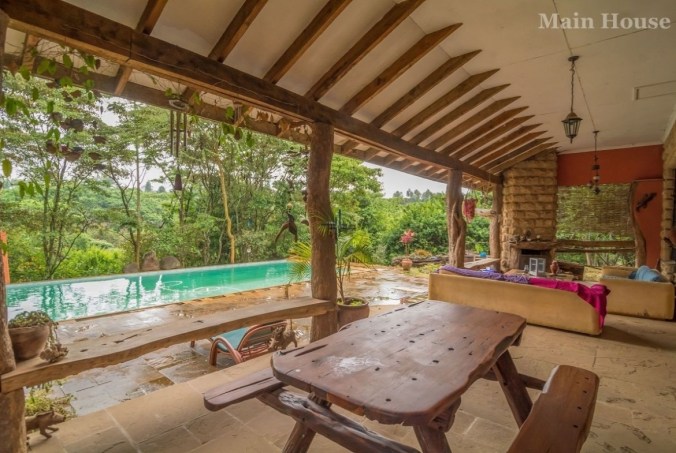
A lot of my net worth is property equity which is not really accessible but means I can dream about living in a fabulous house like this on in Nairobi…
Property
So 60% of my net worth is property equity. This is across two homes. I rented out my main residence in the UK when I got a job overseas and it is still tenanted. This means that the interest rate isn’t great (abot 4%) but I have focused on paying off this mortgage as a matter of priority. That’s based largely on my risk appetite (AKA terror of losing my job and making my kids homeless) and whilst I realise it might not be the most rationale approach to wealth building, it gives me a sense of comfort. I had a huge deposit from the sale of my previous home, so the mortgage was only £156,000 to start with and I have paid off £111,000 in the past six years.
This property is also my only passive income stream, bringing in £1,250 gross, or about £900 net of all costs since I have a letting agent manage it and of course have to ensure that everything is in good working order.
My second property is the home that we live in in Denmark. I wrote a lot about the decision to buy, and then about freaking out about the cost of property here but on balance I still think it was the right decision. Aside from the ridiculous cost of rent, the housing market is crazy at the moment and I have friends who cannot find places to rent. So again – it’s not just a financial decision but one about stability.
I don’t try and overpay the mortgage on this house. Partly because it’s so huge I just won’t make a dent, but also because we will sell this when we move country again. So since housing is a significant monthly cost, I just pay it and hope that I get a return on investment that is better than paying rent to someone else.
I am interested in having more of a property porfolio but it’s so hard in the UK. I listen to a lot of great FIRE podcasts from the US and everything – from the financing, to the market – just seems miles away. There are also ethical issues, in both directions, about being a private landlord but that’s a post for another day.
Savings
The result of buying a second home though was that my savings and investments took a massive hit. I went from almost £100,000 in savings to around £20,000 which I have built back up. That amount includes my emergency fund of £10,000 and the rest is in a stocks and shares ISA.
This is the area that I really want to focus on as there is so much room for growth. I also feel very property heavy in terms of the portfolio overall, and it’s money that just stays tied up.
Whether you’re saving for a rainy day or a cloud forest holiday, this is the most flexible part of your portfolio. Photo by Vlad Bagacian on Unsplash
Pensions
So this is the confusing area I think. Most of the FIRE community talks about total pension pots, and for me that is around
But the majority of my pensions are defined benefit which works totally differently. Have a look here for a simple explanation but basically, defined benefit means that the pot doesn’t really matter: what I will receive as a pension is guaranteed. This is a great place to be in lots of ways, though it is limited in terms of flexibility. I can’t, for example, decide where those pensions are invested. But in terms of security and planning they really work.
So what is interesting is not so much the overall pot as how much each one will pay out in retirement. The figures below show both the current pot value calculated as the transfer value (what I would get if I cashed out or wanted to move it) and also what it’s scheduled to pay out. All of the defined benefit schemes pay out when I am 67, so I also need to focus on what could be quite a long period to bridge if I want to retire at 50.
One thing to note is that the third pension pot will pay that out if I carry on contributing at this level for another two years – if I leave the job before then, they just pay me out the transfer value. So I need to stay here at least a bit longer!
Pensions
Transfer value
Pension on retirement
TOTALS
£ 234,973
£23,316
SIPP
£ 42,983
£400
Defined benefit pension 1
£ 39,462
£1,400
Defined benefit pension 2
£ 62,304
£6,250
Defined benefit pension 3
£ 90,224
£15,266
You can see from this that they aren’t all equal. Each one has a totally different rate of return.
It does make me question the value of investing in the SIPP, as works out as a 1% rate of withdrawal which doesn’t seem that smart. Once I lock in my defined benefit pensions, I might stop this one and focus on saving and investing in other ways.
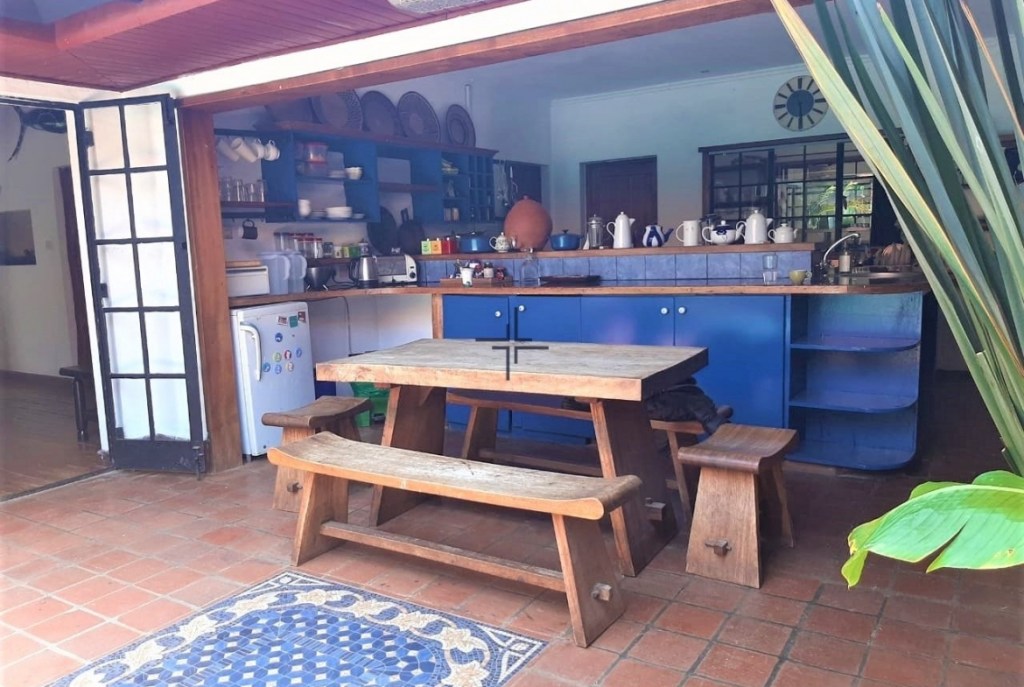
So that’s it. There are other very small pots in there like crypto but these are the real pillars of my financial plan. I do need to think about rebalancing them but for now I will end on a picture of the kitchen from that same house – because dreaming big is what it’s all about.
I originally posted this in February 2021, but it contains such critical reflections on financial inequalities that face single parents that I wanted to come back to it. Things are even worse one year on: the impact of repeat COVID lockdowns but without the financial cushioning; soaring utility costs; rising inflation – in short, a cost of living crisis which is exacerbated by stagnant wages and new challenges in juggling work and childcare. So I have made some updates but the message is broadly, unhappily, the same.
Being a jolly sort of soul (and, obviously, single), Valentine’s Day seemed like the perfect time. I considered doing a post on self-care and self-love and how this relates to FIRE, but whilst it’s great to work on being positive and hold yourself to account, sometimes it’s necessary to look at structural inequalities and burn. it. all. down.
This isn’t a post about how hard it is to do all of this on one income, though that’s true. There are more single people in the world than ever, around 45% of the adult population in the global North, and there is evidence that they are happier than married counterparts. I am not an evangelist for the single state – indeed I would be happier in a commune than living alone – but I do sometimes imagine what I could achieve if I was part of a couple with the added energy, income, time and other resources and it makes me dizzy.
There’s a lot of love out there, even if you’re single. Duh. Photo by Paweł Czerwiński on Unsplash
So no, it’s not just jealousy or the basic ‘2 incomes is better than 1’ point. In the UK and many other countries, ‘couple privilege‘ is a real thing: outside of the obvious difference in having two incomes, there are tax privileges to having a spouse for example. There are a myriad of hidden costs to being single, from holidays to supermarket norms, not to mention the cost of housing and how single people are viewed as a greater risk in terms of accessing a mortgage.
Research in the UK shows that this approach has been so successful that it is not possible for a single parent on median earnings to reach a decent minimum living standard. Indeed, the gap between earnings and costs are getting worse thanks for austerity and benefit cuts, and price rises. For lone parents working full time on median earnings, the shortfall has risen from 6% to 16% in the past ten years.
In 2019, the overall cost of a child up to age 18 years (including rent and childcare) was £185,000 for lone parents (up 19% since 2012) and £151,000 for couples (up 5.5% since 2012). A greater cost, on half the possible income. It feels hard because it IS hard.
In a previous job where I was posted overseas for a British company there were significant benefits available for a spouse that I was unable to tap into for either of my children’s secondary parents – their father, or their grandmother. These benefits included the cost of flights to spend time with us, or if one of them had wanted to live with me, pension contributions. I lost out on around £20,000 per year because those benefits could only go to someone with whom I had a very particular intimate relationship. I felt totally judged by 1950s hetero normative rules: you can have the money if you still go to bed with the person with whom you had children, but if not, forget it.
The attitudes here, both in the treatment of those on benefits and low wages, and those of us in a much higher tax bracket, are united by the same message. You have failed, and you should be ashamed.
I am blessed to be able to bring up my children without stinting – on luxuries as well as the basics, where we are frugal it’s out of choice – but I am also constantly anxious about what happens if I can’t work. We don’t have a second income to lean back on. We don’t have a plan B.
Lessening that anxiety is one of the reasons that financial independence is worth so much as a single parent. There are loads of brilliant exes out there who co-parent and equally share the financial burden but I can honestly say that I don’t know any of them myself. When you have sufficient issues with someone that you made the enormous decision to break up your family, relying on them financially can be challenging however easy it is. Sometimes the plan B just isn’t possible.
But sometimes, we also need to think about how society – and communities like FIRE – can help us create new plans. Love is so much more than just romantic: for our kids, for our community, our planet and each other. Happy valentine’s day to us all.
I wanted to start off this year recognising that there seems to be an epidemic of loneliness. This has real implications for us as a society, and I believe means specific things for those of us who were already on solo journeys before all the craziness of COVID cut off our social networks.
And loneliness really matters, not just for mental wellbeing but also for our physical health. Feeling isolated is linked to early mortality, poor cardivascular health, depression and suicide. In fact it is so serious that the negative health impact of loneliness is akin to smoking 15 cigarettes a day. Sometimes when I feel lonely I also feel a bit ashamed about it, like I’m the unpopular kid at school standing in a corner whilst the fun and noise goes on around me. But reminders about the impact of feeling like this means it’s important to sometimes look it in the eye.
In my own social circles I see real evidence of people struggling to feel connected and secure, and it’s something that I have noticed in myself as well.
Being a single parent is a pretty lonely place. Being responsible for all the decisions and actions, being good and bad cop, and being where the buck stops on All. The. Things. can get exhausting. Add into the mix the other things that I’m trying to do, whether in terms of work, family, friendship or interests, and the spinning plates sometimes drop. Then add in trying to follow the road less travelled into FIRE, female senior leadership and mindful living and sometimes I feel like a leaf being blown about in a gale.
I also recognise that not all cultures operate in the same way, so the kinds of family or community that might lean in to support me don’t really exist in Europe. The rise of one-person households; the culture of ‘busyness’; urban planning and how we interact with our neighbours; work culture: all of these things create friction in human interactions which in turn increases the sense of isolation.
In spite of this, recognising that loneliness comes with going down the road less travelled, loosens its negative grip on me. So ok, single parenting is lonley precisely because we are doing it alone. And having a vision outside of the norm – following FIRE, being an entrepreneur or a leader – necessarily means carving your own path. Sometimes that path feels lonely and sometimes it feels liberating.
So what are the opportunities to mitigate loneliness whilst still creating your own life? The first strategy has to be around building a stronger community. Maybe it’s taking time to speak with your friends – and really speak with them, not just having a laugh down the pub (though that has its mental health benefits too…). Maybe it’s engaging family, or working on some of the more challenging relationships which support your healing. Maybe it’s joining up with, or building a new community, whether in your neighbourhood or online.
My second strategy is around focusing on the calendar. Whilst Judaism has traditions which mark the weeks and phases of the year, the main thing for me is to recognise the seasons and celebrate or act in accordance. This is even more important to me since living in Denmark where the winter can feel depressing and lonely, and taking it gently matters more. Having rituals or activities which mark the passing of the seasons – from new year’s resolutions, to the new school year – makes me feel more like an active participant in something positive.
Finally perhaps it’s about learning to listen, and to be heard. Being prepared to open up, to share what isn’t working and ask when you need something, matters. Listening and being open to hearing difficult things from others, also matters. Building meaningful connections can take time and can be challenging – especially if you are feeling low – but it’s really worth it.
So – what are your ideas for combatting loneliness? Wishing you a happy and nourishing 2022!
Whilst I will come back to the ‘Creating the future’ thinking, this week it’s Hannukah, so I wanted to stop for a minute and think about miracles, and gratitude. It’s a recurring theme in this blog, but it’s something which is central to how I think about mindful living – and let’s face it, more gratitude in this sometimes cold and scary world can only be a good thing.
Hannukah celebrates the story of power over adversity, and of accepting grace. It’a basd on a historical story from Jerusalem in 168 BC when the Greeek king Antiochus IV Epiphanes banned Jewish practice and defiled the Jewish Temple in the city by installing an alter to Zeus and sacrificing pigs. The Maccabees, a small army of Jews (and not a football team) rebelled, regaining control of the temple where they removed the false alter and worked to reconsecrate the temple. But there was only enough oil to burn for one day which wasn’t enough for the necessary rituals. And then the miracle occurred, and the oil burned for eight days.
There’s a lot of discussion about how Hannukah was a minor Jewish festival which has become increasingly visible because it’s fun (candles, doughnuts and games – what’s not to like?!), and it’s usually around Christmas. But I love it because it’s a time of year to celebrate the miracles which surround us, and sit and stare in wonder.
But why does that matter? To me it matters because within the noise of the daily struggle, the challenges of striving and growing, the sheer astonishing, fierce, splendid grind of being human, we need to make time to be quiet. Not just to go inside yourself and see what’s there, but to get to the horizon where your power ends and feel your way into what higer power is with you.
At Hannukah you usually say ‘a miracle happened here’ if you’re in Israel, but I like to say it because miracles are happening to and within us all, all the time. Rabbi Heschel, philosopher and civil rights activist who marched with Dr King, talks a lot about why taking time to recognise this matters, saying:
People of our time are losing the power of celebration. Instead of celebrating we seek to be amused or entertained. Celebration is an active state, an act of expressing reverence or appreciation. To be entertained is a passive state: it is to receive pleasure afforded by an amusing act or a spectacle…. Celebration is a confrontation, giving attention to the transcendent meaning of one’s actions.
Source: The Wisdom of Heschel” ― Abraham Joshua Heschel
There’s a lot of evidence that gratitude makes you happier – that people who make time to be thankful have better health, stronger relationships, and are more robust. And it makes sense if you are focused on working toward your goals that not stopping to celebrate how far you’ve come will rob you of opportunities to be proud and joyful. And they are all feelings you need, to spur you on as you climb your next mountain.
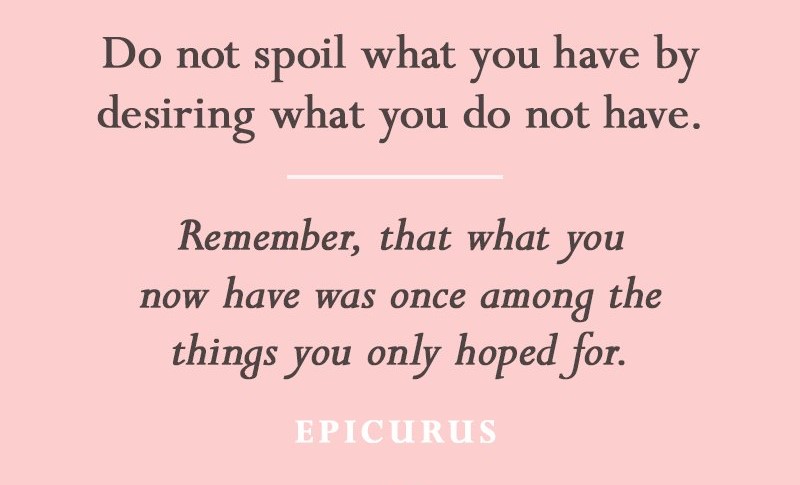
From Epicurus, who was around at the same time as the sacking of the Temple
So this week,I suggest taking some time to pull over for a minute from the highway swerving of your day-to-day and taking a moment to celebrate what has happened in your life. A miracle happened here.












 Brilliant Ladies' Handbag Club